AI Agent Governance: The Complete Guide for Enterprise Control and Security
Secure, Scalable, and Compliant AI Agent Management
In 2025, enterprises face a critical challenge: how to harness the transformative power of AI agents while maintaining security, compliance, and operational control. As organizations deploy increasingly autonomous AI systems across their operations, the question is no longer whether to adopt AI agents, but how to govern them effectively without sacrificing innovation velocity.
AI Agent Governance represents the structured framework of policies, processes, and technical controls that enable enterprises to deploy AI agents responsibly at scale. This comprehensive approach addresses security, compliance, accountability, and ethical considerations while ensuring AI systems align with business objectives and regulatory requirements.
Understanding AI Agent Governance in the Modern Enterprise
Traditional IT governance frameworks weren't designed for the unique challenges AI agents introduce. Unlike conventional software that executes predefined instructions, AI agents make autonomous decisions, interact with multiple systems, and adapt their behavior based on data and feedback. This autonomy creates governance complexities that demand specialized approaches.
Organizations deploying AI agents without proper governance face significant risks including data breaches, compliance violations, intellectual property exposure, and reputational damage. The rapid adoption of generative AI tools like ChatGPT and Claude across enterprises has created an urgent need for structured oversight, as many teams deploy these powerful systems without clear policies, security controls, or accountability measures.
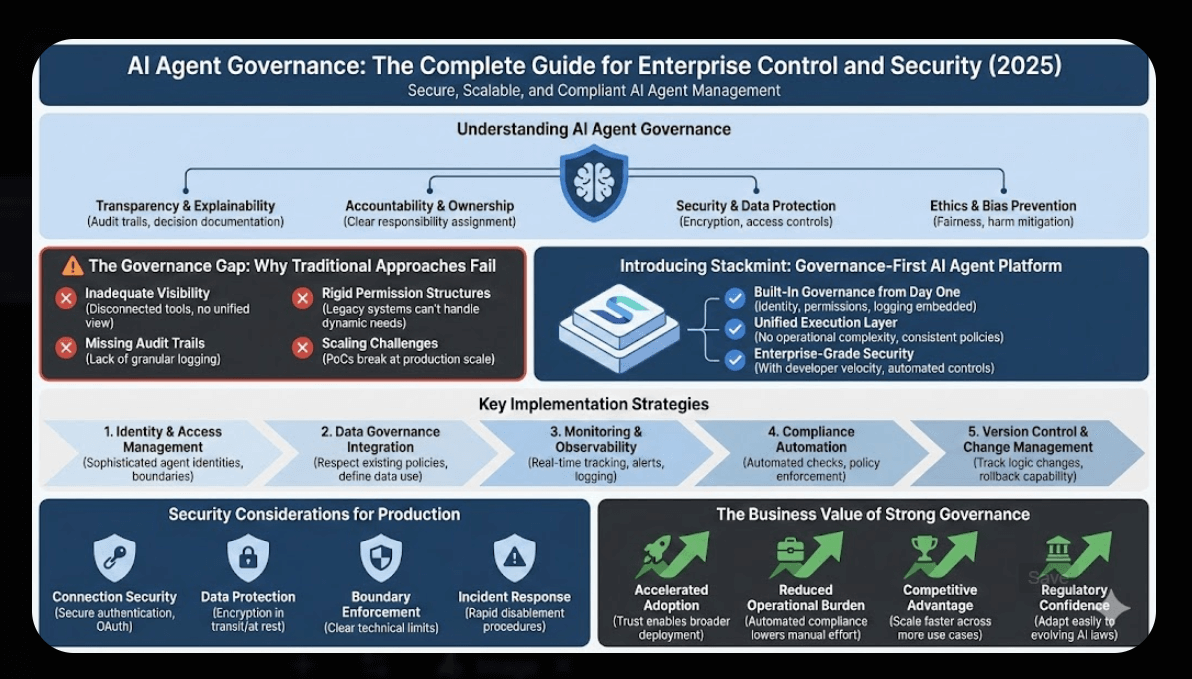
Effective AI agent governance rests on four foundational pillars that organizations must address systematically:
Transparency and Explainability
AI agents must operate in ways stakeholders can understand and audit. This includes documenting how agents make decisions, what data sources they access, their operational limitations, and how their activities are monitored. Transparency becomes critical as regulations like the EU AI Act mandate explainability for high-risk AI applications.
Accountability and Ownership
Clear assignment of responsibility for AI agent decisions, outcomes, and oversight ensures someone owns the remediation process when systems fail or cause harm. Organizations must designate specific individuals or committees spanning Security, Risk, Compliance, Legal, and Technology who are responsible for agent governance.
Security and Data Protection
AI governance frameworks must prioritize safeguarding data and systems from breaches and misuse. This requires strong encryption, regular security audits, and robust data governance strategies to protect sensitive information that AI agents process and access.
Ethics and Bias Prevention
Addressing algorithmic bias, fairness considerations, and harm prevention in AI operations ensures agents operate within ethical boundaries that reflect organizational values and societal expectations.
The Governance Gap: Why Traditional Approaches Fail
Many enterprises attempt to apply existing IT governance frameworks to AI agents, only to discover critical gaps that expose their organizations to risk. Traditional approaches fail for several fundamental reasons:
- ✖ Inadequate Visibility: Point solutions and disconnected tools create security gaps between systems, forcing organizations to manage disparate monitoring capabilities without unified visibility into agent operations. When hundreds of AI agents operate simultaneously across departments, inconsistent oversight makes it impossible to maintain comprehensive governance.
- ✖ Rigid Permission Structures: Legacy access control systems weren't designed for the dynamic, context-aware permissions that AI agents require. Agents need to access different data sources and systems based on user identity, task requirements, and real-time business context while maintaining security boundaries.
- ✖ Missing Audit Trails: Understanding agent behavior requires detailed logging of every decision, data access, and action taken. Basic monitoring systems lack the granular audit capabilities needed to track which data sources influenced specific AI decisions or reconstruct agent reasoning chains for compliance reviews.
- ✖ Scaling Challenges: Governance approaches that work for proof-of-concept deployments with isolated datasets and simple access controls fundamentally break down at production scale. Processing sensitive enterprise data across multiple environments while integrating with existing business systems requires sophisticated controls that sandbox solutions cannot provide.
Introducing Stackmint: Governance-First AI Agent Platform
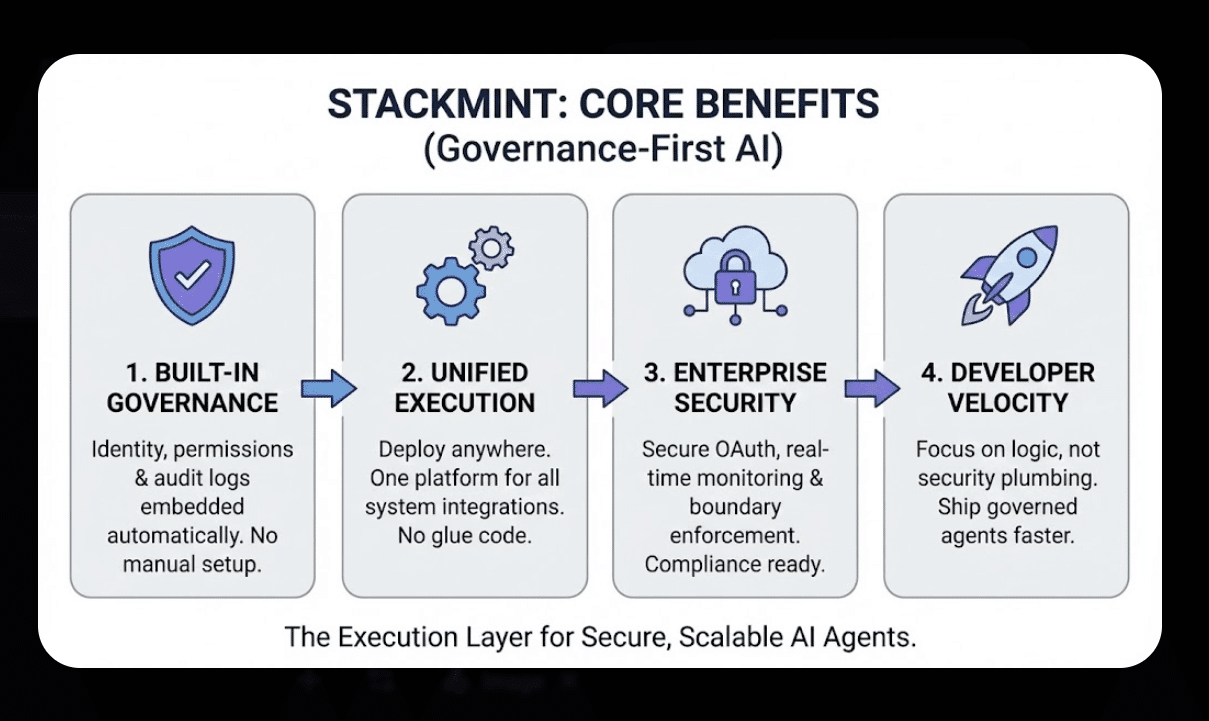
Stackmint represents a fundamental shift in how organizations approach AI agent governance. Rather than retrofitting security and compliance onto experimental platforms, Stackmint builds governance directly into the execution layer, making it impossible to deploy ungoverned agents.
As the execution layer for enterprise AI, Stackmint enables organizations to build and run governed AI workflows that integrate seamlessly across their technology stack. The platform's architecture addresses the governance challenges that plague traditional approaches through three core differentiators:
Built-In Governance from Day One
Unlike platforms that treat governance as an add-on feature, Stackmint embeds identity management, permission controls, and audit logging into every workflow out of the box. Organizations don't need to configure complex security rules or implement additional monitoring tools because governance mechanisms operate automatically from the moment agents start running.
This governance-first architecture means that when teams build agents using Stackmint's Buds (logic components) and Branches (workflows), security policies and access controls are automatically inherited and enforced. Every connection to systems like Salesforce, Slack, Google, databases, and custom APIs is secured through OAuth, with permissions managed centrally rather than scattered across individual integrations.
The platform maintains comprehensive audit trails that record who ran which agents, when they executed, what data they accessed, and what actions they performed. This granular logging provides the visibility enterprises need for compliance reviews, security investigations, and continuous improvement of agent behaviors.
Unified Execution Layer Without Operational Complexity
Traditional agent deployments require extensive custom integration work and operational overhead to maintain security across disparate systems. Organizations struggle with glue code connecting different tools, inconsistent policy enforcement across environments, and the burden of maintaining custom operations infrastructure.
Stackmint eliminates this complexity by providing a unified execution layer where agents run consistently regardless of the underlying systems they interact with. Teams can deploy agents across their entire technology stack without writing integration code or managing custom operations infrastructure. The platform handles the operational complexity of secure multi-system integration while maintaining governance standards automatically.
This architectural approach means security teams maintain consistent visibility and control without becoming bottlenecks to innovation. Developers and business users can build and deploy agents rapidly using natural language or visual editors, while security policies enforce boundaries automatically in the background.
Enterprise-Grade Security with Developer Velocity
The traditional tension between security requirements and development velocity disappears when governance is embedded at the platform level. Stackmint enables organizations to move fast without breaking compliance or security posture.
Agents built on Stackmint can be scheduled to run automatically, triggered by specific events in connected systems, or exposed via API for integration with other applications. Throughout all these execution modes, the platform maintains real-time monitoring and governance controls without manual intervention.
For organizations requiring additional compliance capabilities, Stackmint's architecture supports the monetization features needed for internal chargebacks or external service delivery. This Stripe-ready billing integration means teams can track agent usage, attribute costs accurately, and maintain financial governance alongside technical controls.
Implementing Effective AI Agent Governance
Organizations at different maturity stages require tailored approaches to AI agent governance. The journey typically progresses through three phases:
- Informal Governance: Early-stage organizations operate with ad hoc policies and manual oversight processes. Teams experiment with AI agents but lack standardized frameworks for security, compliance, or accountability. This phase carries significant risk but provides learning opportunities.
- Structured Governance: Developing organizations formalize policies, standardize approval processes, and implement monitoring capabilities. They establish clear roles and responsibilities, document agent behaviors, and begin tracking compliance systematically. Platforms like Stackmint accelerate this transition by providing governance infrastructure out of the box.
- Mature Governance: Optimized organizations implement automated governance frameworks with continuous monitoring, policy-as-code enforcement, and predictive risk analytics. They integrate AI governance with broader enterprise risk management, enabling holistic visibility into technology risks and business impacts across complex agent ecosystems.
Key Implementation Strategies for AI Agent Governance
Successful AI agent governance requires strategic implementation across several critical dimensions:
Identity and Access Management
Implement sophisticated identity management that supports both human users and AI agents as first-class entities in your access control framework. Define clear boundaries around what agents can access based on user identity, task requirements, and operational context. Leverage platform capabilities that enforce these permissions automatically rather than relying on manual configuration.
Data Governance Integration
Ensure AI agents respect existing data governance policies while extending controls for agent-specific concerns. Define which data sources agents can access for training and inference, how they handle sensitive information, and what data retention policies apply to agent outputs and logs.
Monitoring and Observability
Deploy comprehensive monitoring that tracks agent behavior in real-time, logs all decisions and actions, and provides alerts when agents operate outside expected parameters. Stackmint's built-in observability enables teams to monitor agent execution continuously without implementing custom logging infrastructure.
Compliance Automation
Automate compliance checks and policy enforcement rather than relying on manual reviews. Platform-level governance ensures agents cannot violate security policies even if developers make mistakes during implementation. This approach reduces compliance burden while maintaining rigorous standards.
Version Control and Change Management
Maintain strict version control over agent logic and workflows. Track who makes changes, when modifications occur, and what impact updates have on agent behavior. Stackmint's architecture treats Buds and Branches as versioned components, enabling teams to roll back changes and audit modification history systematically.
Security Considerations for Production AI Agents
Moving AI agents from experimental deployments to production environments requires heightened security attention across several domains:
- Connection Security: Ensure all system integrations use secure authentication mechanisms like OAuth rather than embedded credentials. Stackmint's connection management centralizes credential storage and enforces secure authentication patterns automatically.
- Data Protection: Implement encryption for data in transit and at rest, with special attention to sensitive information agents process. Define clear policies for how agents handle personally identifiable information, financial data, and other regulated data types.
- Boundary Enforcement: Establish clear boundaries around agent capabilities and ensure technical controls prevent agents from exceeding their authorized scope. Platform-level enforcement provides stronger guarantees than application-level restrictions.
- Incident Response: Develop incident response procedures specific to AI agent failures, security breaches, or compliance violations. Include capabilities to rapidly disable problematic agents, investigate root causes, and implement corrective measures.
The Business Value of Strong AI Agent Governance
Organizations that invest in robust AI agent governance realize significant business advantages beyond risk mitigation:
- Accelerated Adoption: When stakeholders trust that agents operate securely and compliantly, they support broader deployment. Strong governance removes barriers to production deployment that plague organizations with weak controls.
- Reduced Operational Burden: Automated governance reduces the manual effort required to maintain compliance and security. Security teams focus on strategic initiatives rather than constant firefighting around agent deployments.
- Competitive Advantage: Organizations with mature governance can deploy AI agents across more use cases and operate them at greater scale than competitors struggling with governance challenges. This capability translates directly into operational efficiency and market advantage.
- Regulatory Confidence: As AI regulations evolve globally, organizations with established governance frameworks adapt more easily to new requirements. They possess the visibility, controls, and documentation that regulators increasingly demand.
Conclusion: Governance as a Growth Enabler
AI Agent Governance isn't merely about restriction and control; it's about enabling safe, rapid innovation at enterprise scale. The right governance framework transforms AI agents from experimental curiosities into business-critical capabilities that deliver measurable value.
Platforms like Stackmint demonstrate that governance and velocity aren't opposing forces. By embedding security, compliance, and observability directly into the execution layer, organizations achieve both the control they need and the speed their business demands.
As AI agents become increasingly central to enterprise operations, the question isn't whether to implement governance but how quickly organizations can establish frameworks that support responsible innovation. Those who act decisively gain first-mover advantages in the AI-driven economy, while those who delay accumulate technical debt and governance gaps that become exponentially harder to address.
The future belongs to organizations that govern their AI agents as rigorously as they govern their human workforce, establishing the accountability, transparency, and security that stakeholder trust requires. Start building your AI agent governance framework today with platforms designed for this purpose from the ground up.
Explore the Stackmint Marketplace